Workplace Noise: The Invisible Risk That Costs UK Businesses Millions
Noise Awareness Training – Why It Matters
Workplaces should hum with productivity, not reverberate with a cacophony of noise.
Yet, across the UK, many work environments grapple with an invisible menace: excessive noise.
While most employers diligently manage obvious safety risks like trips or falls, noise is frequently overlooked. It is a threat that affects our well-being and our ability to thrive.
Noise awareness training is crucial to address this issue.
How You Can Deal With Workplace Noise
This guide explores why noise matters, the strict UK regulations you must follow, and how recent HSE prosecutions prove that ignoring this risk can be financially devastating for you or your business.
More Than Just “Background Noise”
We often ignore the “usual suspects”: plant machinery, blaring radios, or the hum of a busy server room. Even “sneaky culprits” like air conditioning units and keyboard clicks can add up, creating a low-level buzz that destroys concentration.
But the risk goes beyond annoyance.
Permanent Hearing Loss: Prolonged exposure destroys the delicate hair cells in the ear. Once gone, they do not grow back.
Tinnitus: This condition—a permanent ringing or buzzing—can be more debilitating than deafness itself. In the early 20th century, it was known as “Boilermaker’s Ear” because industrial riveters suffered from it so frequently.
Stress & Safety: Constant noise releases stress hormones, leading to fatigue and anxiety. It also hampers communication; if you can’t hear a warning shout or a reversing vehicle, the results can be fatal.
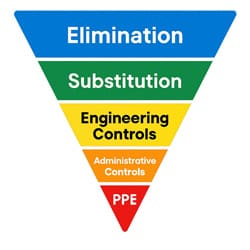
The Health & Safety Executive Hierarchy Of Controls
The Health & Safety Executive Have A Hierarchy Of Controls For Risks In The Workplace
Most Effective
Physically remove the hazard – clear it away
Replace the hazard – with safe equipment
Isolate people from the hazard – erect barriers
Change the way people work – train them
Protect workers with Personal Protective Equipment
Least Effective
The 3dB Rule: A Critical Concept
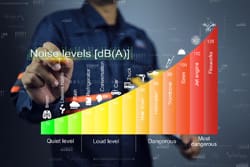
Many managers misunderstand how sound works. Noise is measured in Decibels (dB), which uses a logarithmic scale.
This is the most important thing to remember: An increase of just 3dB doubles the sound energy.
80 dB(A): Safe for a maximum of 8 hours. It is not wise to have this exposure continuously.
83 dB(A): Twice as much sound energy – protect your hearing and limit exposure to maximum 4 hours in an 8 hour workday.
85 dB(A):Five times greater intensity than 80dB. The World Health Organization (WHO) suggests a limit of about 12.5 hours per week for 85 dB – but at this level you should have hearing protection on.
The danger from noise increases logarithmically – that’s why noise awareness is so important
A small increase on the noise meter equals a massive increase in risk to your hearing.
The Law Relating To Workplace Noise: Know Your Numbers
Historically, noise fines were small. That has changed. Since sentencing guidelines were updated in 2016, fines are now based on a company’s turnover, not their profit.
The Health & Safety Executive (HSE) is currently targeting “Health Risks,” often bundling noise breaches with vibration (HAVS) offences.
Fibreline: A furniture manufacturer introduced new machinery that raised noise levels. They failed to update their risk assessments for seven years. The firm was fined £15,000 and ordered to pay costs of £4,457
The Lesson: A £10k fine could close a small business – You cannot simply buy earplugs and forget about the paperwork!
How To Avoid Getting Fined Because Of Workplace Noise
Identify The Risks – what machinery/tools/equipment do your people use? Do they drive vehicles/operate machinery? – Even the humble vacuum cleaner makes a noise!
Decide what to do – which may be to replace the offending machine, or keep people away from the area it is being operated in. But don’t forget the ambient noise in your office!
Measure and monitor – the amount of noise and the exposure people have to it. And keep records of the information and your actions.
Issue personal protective equipment to anyone who is at risk from workplace noise, make sure they know how to use it and enforce the requirement to do so. (There’s a common myth that people don’t have to wear PPE if they don’t want to. You are perfectly entitled to make it a mandatory requirement – after all, you’re going to be the one in Court if action is taken!)
Train your people so they are aware of the dangers of workplace noise and keep records of attendance. Online courses are available which are simple and convenient, eliminating the need for staff to be absent from their workplace.
The best way to avoid warnings or prosecution is to be in a position where you can justifiably show the Health & Safety inspector you have take all the actions that can be resonably expected to eliminate/mitigate the risks associated with workplace noise.
Where There’s Blame, There’s A Claim……..
Not all the liability comes from the HSE – people whose hearing is damaged as a result of a noisy workplace have recourse to the High Court and can take action to claim compensatory damages.
There are ‘no win, no fee’ lawyers who actively market the possibility of getting compensated for noise-related hearing loss. I’ve personally had ‘cold’ calls from such firms.
Defending such a claim is time-consuming and expensive and whilst businesses have liability insurance, the far better thing is for them to have all the policies and procedures in place not only to defend a claim, but avoid one being made in the first place.
How to Measure Workplace Noise
You can’t manage what you don’t measure!
1. Sound Level Meters
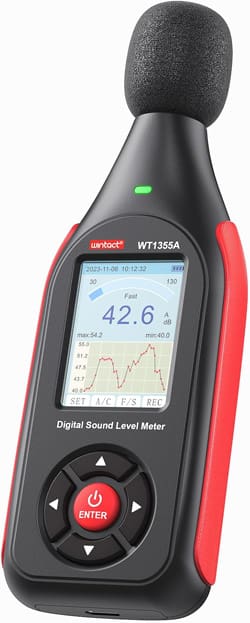
These are the most accurate method for taking a “snapshot” of noise in a specific area.
They measure sound pressure in decibels (dB) and use “A-weighting” to mimic the sensitivity of the human ear.
Basic models can cost as little as £30.00
Noise measuring devices are readily available – this one is about £30.00
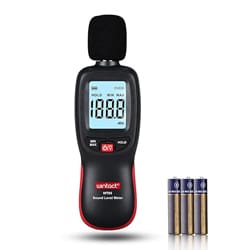
2. Noise Dosimeters
For workers who move around—like maintenance staff or construction workers—a static reading isn’t enough.
A dosimeter is a small wearable device that tracks an employee’s total noise exposure.
Monitoring is far better than just spot measuring and provides readily available evidence of a structured approach to the issue of workplace noise.
They are also available at about £30.00
Noise Dosimeters Provide Comprehensive Information for about £30.00
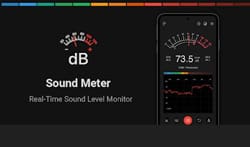
3. Smartphone Apps
While useful for a quick check, apps are not accurate enough for legal compliance.
If you use one, treat it as an indicator only, not a formal assessment.
You can get Smartphone Apps that measure noise, but they cannot be relied on for workplace noise records
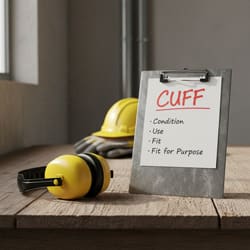
Taking Action: The “CUFF” Rule for PPE
When engineering controls (like silencers or soundproofing) aren’t enough, you must rely on PPE. However, handing out ear defenders isn’t enough. You must ensure they work.
What Is The Best Way To Make Sure People Have the Right PPE?
We recommend using the HSE’s “CUFF” Check during your toolbox talks and staff briefings:
Condition: Is the PPE damaged or worn out?
Use: Are they wearing it 100% of the time in the noisy zone? Removing it for just a few minutes drastically reduces protection.
Fit the Ear: Is the seal tight? (Glasses or long hair can break the seal of earmuffs).
Fit for Purpose: Is the protection level correct? (Blocking too much sound can be dangerous if workers cannot hear alarms).
‘CUFF’ – The Easy Way To Check Hearing Protection
Next Steps: Protect Your Team
Noise awareness training is essential for organizations to protect employees. It educates workers on how to recognize hazardous levels and use equipment correctly.
What are the legal workplace noise limits in the UK?
Under the Control of Noise at Work Regulations 2005, there are three key levels: 80 dB(A) (Lower Action Value): Employers must provide training and make hearing protection available. 85 dB(A) (Upper Action Value): Mandatory “Hearing Protection Zones” must be established, and PPE must be worn. 87 dB(A) (Exposure Limit Value): The absolute maximum noise level allowed, taking the effect of hearing protection into account.
How often should I carry out a noise risk assessment?
You should review your noise assessment at least every two years. However, if you add new machinery, change working patterns, or alter the building structure, you must conduct a new assessment immediately to ensure your current data is accurate.
What is the “3dB Rule”?
This is a critical concept for safety. Because sound is measured on a logarithmic scale, an increase of just 3 decibels (dB) doubles the sound energy. This means 83 dB is twice as intense as 80 dB. A small increase on the meter represents a massive increase in risk to your hearing.
Can I rely on smartphone apps to measure noise?
Smartphone apps are useful for a quick estimate, but they are not accurate enough for a legal risk assessment. For compliance, you must use a Class 1 or Class 2 Sound Level Meter or a wearable Noise Dosimeter that meets British Standards.
What is the “CUFF” check for ear defenders?
The CUFF check is a quick method to ensure hearing protection is working effectively: Condition: Is the equipment damaged? Use: Is it worn 100% of the time in the noisy zone? Fit: Is the seal tight against the ear? Fit for Purpose: Is the level of protection correct for the environment?
Can employers be fined for noise breaches?
Yes. The HSE can prosecute businesses for failing to manage noise risks. Fines are now based on turnover, not just profit. Recent cases have seen SMEs fined up to £100,000 for failing to assess risks, even if no specific injury had yet occurred.
Who needs Noise Awareness Training?
Any employee who is liable to be exposed to noise at or above the lower action value of 80 dB(A) should receive training. This ensures they can recognize the risks, use their PPE correctly, and identify early symptoms of hearing loss.
What are the early symptoms of noise-induced hearing loss?
The first signs are often difficulty following conversations in crowded rooms (known as the “Cocktail Party Effect”) and Tinnitus—a permanent ringing or buzzing in the ears. This damage is often permanent.
Can I just provide earplugs and ignore the noise?
No. The law requires you to follow the “Hierarchy of Controls.” You must first try to eliminate or reduce the noise (e.g., using quieter tools or silencers). PPE (earplugs/defenders) is a last resort and should only be used when other measures are not sufficient.
What is “Boilermaker’s Ear”?
“Boilermaker’s Ear” is a historic term for noise-induced hearing loss, originating from industrial workers who riveted metal plates. While the name is old, the condition remains a major risk in modern construction and manufacturing.