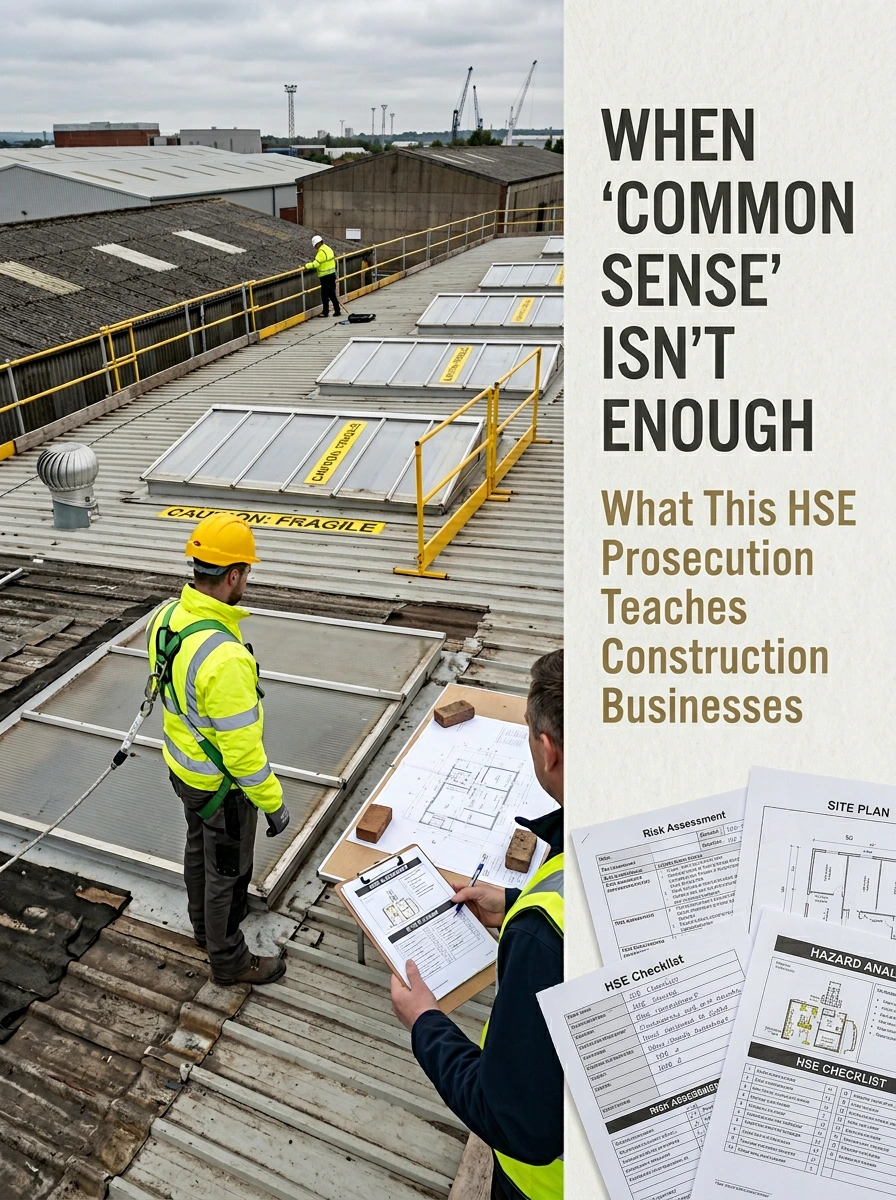
When an accident happens, the HSE doesn’t investigate common sense. It investigates evidence.
One of the most common things I hear when discussing Construction Health & Safety training is: “It’s just common sense.”
Unfortunately, common sense is rarely enough when something goes wrong.
Following a serious accident, the HSE investigators won’t ask whether everyone thought they were working safely.
They will ask whether the work was properly planned, whether risks were assessed, whether workers were trained and supervised, and whether suitable systems were in place to prevent the incident from happening in the first place.
A dreadful accident that changed a young man’s life in an instant.
A 26-year-old scaffolder was lucky to survive after falling more than six metres through a fragile roof light while working on a warehouse roof in West Yorkshire.
Our thoughts are with James Cranswick, who suffered significant injuries in this incident, including broken bones and head wounds.
The purpose of this article is not to criticise an injured worker, but to highlight the lessons every construction business can learn from the HSE investigation.

While the accident itself was shocking, the Health and Safety Executive’s investigation focused on something equally important: the systems, planning and management that should have prevented it from happening in the first place.
What The HSE Actually Found
- Work was not properly planned.
- Work was not properly monitored.
- Fragile roof areas had not been adequately protected.
- Suitable fall prevention measures were absent.
- Workers were exposed to foreseeable risks.
These findings are important because the HSE did not simply ask what happened. They asked why it happened and whether the companies involved had done enough to prevent it.
The Hidden Cost Of Construction Health & Safety Failures
The fines totalled more than £79,000.
But that is rarely the true cost.
Additional costs often include:
- Legal representation.
- Investigation time.
- Lost contracts.
- Increased insurance premiums.
- Reputational damage.
- Staff absence.
- Management time.
- Potential compensation claims.
And in this case one company has already entered liquidation.
Why Training Matters
Effective training helps businesses demonstrate that health and safety is being actively managed rather than assumed.
They will want to see records of both planning and training – that risks are being acknowledged and all reasonable steps are beting taken to mitigate them.
Records can help show:
- Workers have received instruction.
- Risks have been assessed.
- Supervisors understand their responsibilities.
- Safe systems of work have been communicated.
- The business takes its duties seriously.
No training course can eliminate every risk.
However, appropriate Health & Safety training helps businesses identify hazards, implement suitable controls and demonstrate a commitment to protecting their workforce.
The following courses may be particularly relevant for businesses carrying out roof work or managing contractors who do.
Relevant Training For Roof Work
Working At Height
Falls from height remain one of the leading causes of fatal injuries in construction. This course helps workers understand their responsibilities and the practical measures needed to reduce risk.
Introduction To Risk Assessment
Many HSE prosecutions focus on failures to identify and control foreseeable risks. This course explains how to assess hazards and implement suitable control measures.
CDM Regulations Training
The HSE investigation highlighted failures in planning, management and monitoring. Understanding the CDM Regulations helps duty holders fulfil their legal responsibilities.
Personal Protective Equipment (PPE) Training
PPE is rarely the first line of defence, but workers need to understand when PPE is required, how it should be used and its limitations. In this case, a fall restraint should have been provided by the employer/contractor and its use monitored to prevent this accident being so serious.
Asbestos Awareness Training
Many older industrial roofs contain asbestos cement sheets or other asbestos-containing materials. Workers need to understand the risks before starting work.
Common Sense Matters. Evidence Matters More.
Nobody starts work expecting a serious accident to happen.
Most construction businesses genuinely want to keep their workers safe and most workers use their experience and common sense every day to avoid injury.
However, when something does go wrong, common sense alone is unlikely to satisfy an HSE investigation.
Inspectors will want to see evidence that risks were identified, assessed and managed. They will look at training records, risk assessments, method statements, supervision arrangements and whether suitable systems of work were in place before the incident occurred.
They may also examine accident records.
Interestingly, almost every construction business I speak to has an accident book, yet many of those books remain completely empty.
In reality, construction work inevitably results in occasional minor injuries, cuts, scrapes and near misses. An accident book containing no entries at all can suggest that incidents are not being properly reported or recorded, raising questions about the wider health and safety culture within the business.
The legal duties placed upon employers and contractors are set out in legislation such as the Health and Safety at Work etc. Act 1974 and the Construction (Design and Management) Regulations 2015. However, compliance is not simply about understanding the law. It is about demonstrating that practical steps have been taken to protect people from foreseeable harm.
The HSE’s own guidance, Health and Safety in Roof Work (HSG33), provides detailed advice on planning, supervision, fragile surfaces, fall prevention and safe working practices. The risks associated with roof work are well understood and the expectations placed upon employers are clearly documented.
The circumstances that led to James Cranswick’s injuries were as avoidable as they were tragic, and we sincerely wish him well in his continued recovery.
For other construction businesses, this case serves as a timely reminder that health and safety should never be left to chance. Training, planning, supervision, record keeping and effective management are not merely administrative exercises; they are the evidence that demonstrates a commitment to protecting workers and complying with the law.
When an accident happens, the HSE doesn’t investigate common sense. It investigates evidence.