
Recognition of Prior Learning (RPL) – What it is and how we can use it to support your qualification
SuperSkills assessors have been helping experienced tradespeople get their qualifications since 2007 – nearly twenty years.
If you have worked in construction for years, you may already have most of the skills needed for a National Vocational Qualification (NVQ).
You may use those skills every day.
You may have learned your trade on site rather than at college. You may also have worked under skilled tradespeople before taking on jobs yourself.
What you may not have is the certificate to prove it.
This is where Recognition of Prior Learning can help.
RPL allows an assessor to recognise skills and knowledge that you already have. This can reduce the amount of training you need and help make your NVQ assessment much quicker.
However, there is an important point.
RPL does not mean that an assessor simply accepts that you can do the job because you have been doing it for years.
Your experience still has to be proved.
What Is Recognition of Prior Learning?
Recognition of Prior Learning is a formal method of assessment.
It must be applied in accordance with rules set out by Awarding Organisations – the bodies that determine qualification standards.
For SuperSkills Ltd, the awarding organisation is NOCN
NOCN says RPL can be used where a candidate already has the knowledge, skills or understanding needed for part of a qualification and does not need further training in that area. (You can see the full NOCN policy about RPL here.)
In simple terms, the assessor asks:
What can you already do, and how can we prove it?
For an experienced construction worker, that makes much more sense than starting from scratch.
A carpenter who has fitted doors, roofs and first fix timber for ten years does not need a classroom lesson explaining how these jobs are done.
A groundworker who regularly lays drainage, prepares ground and places concrete does not need to be taught basic groundworks again.
However, the assessor must still collect enough evidence to show that the candidate meets the NVQ standard.
That is the difference between having experience and having assessed competence.
What Counts As Evidence for RPL?
There is no single type of evidence that works for every NVQ.
The evidence has to match the units and assessment criteria within the qualification.
NOCN gives several examples of evidence that may be used for RPL. These include written documents, expert witness testimony, professional discussion and reflective accounts.
In construction, useful evidence might include:
- photos or videos of work you have completed;
- site records and job sheets;
- drawings or plans you have worked from;
- method statements or risk assessments;
- records of measurements, materials or setting out;
- evidence from an employer or supervisor;
- suitable expert witness statements;
- previous training records or certificates;
- professional discussion with your assessor; and
- answers to questions about your trade and the work you carry out.
The assessor will decide which evidence is useful.
A photograph of a finished job, for example, may be helpful. But it may not prove who did the work or how it was completed.
Some years ago, a tiling candidate submitted photographs of work he claimed to have carried out in a kitchen. One of our staff recognised them as having been taken from the B&Q website.
That’s why we will generally only accept still photographs with the candidate in them and that we can prove are from work carried out by our candidate.
The assessor will also ask questions about it or seek other evidence to support it.
This is why an NVQ portfolio normally contains a body of evidence, rather than one photograph or document.
What Does an Assessor Look For?
NOCN sets five main tests for evidence used through RPL.
It must be valid, authentic, current, reliable and sufficient.
Those terms sound formal, but the ideas behind them are quite simple.
Valid
Does the evidence actually prove the skill or knowledge required by the NVQ?
A photo of you standing beside a completed roof does not necessarily prove that you installed it.
Authentic
Is it really your work?
The assessor must be confident that the evidence relates to your own skills and competence.
Current
Does the evidence show that you can work to current standards?
Construction methods, products, regulations and safety requirements change. Very old evidence may therefore need checking.
Reliable
Does the evidence show that you can do the job properly again?
An assessor needs evidence of real competence, rather than one job which happened to go well.
Sufficient
Is there enough evidence?
One piece of evidence may cover several assessment points. However, the assessor still needs enough evidence to meet all the relevant requirements.
Does 20 Years in the Trade Automatically Prove Competence?
No.
Experience is very useful, but the number of years you have worked is not evidence on its own.
Someone may have been a carpenter for 20 years. That gives the assessor a good reason to expect a high level of skill.
But on its own, it does not remove the need for assessment.
The assessor still has to check the candidate’s work against the requirements of the NVQ.
The good news is that an experienced tradesperson will usually have many chances to provide the evidence.
Their normal working day may already contain much of what the assessor needs.
How Does the Assessor Check Your Experience?
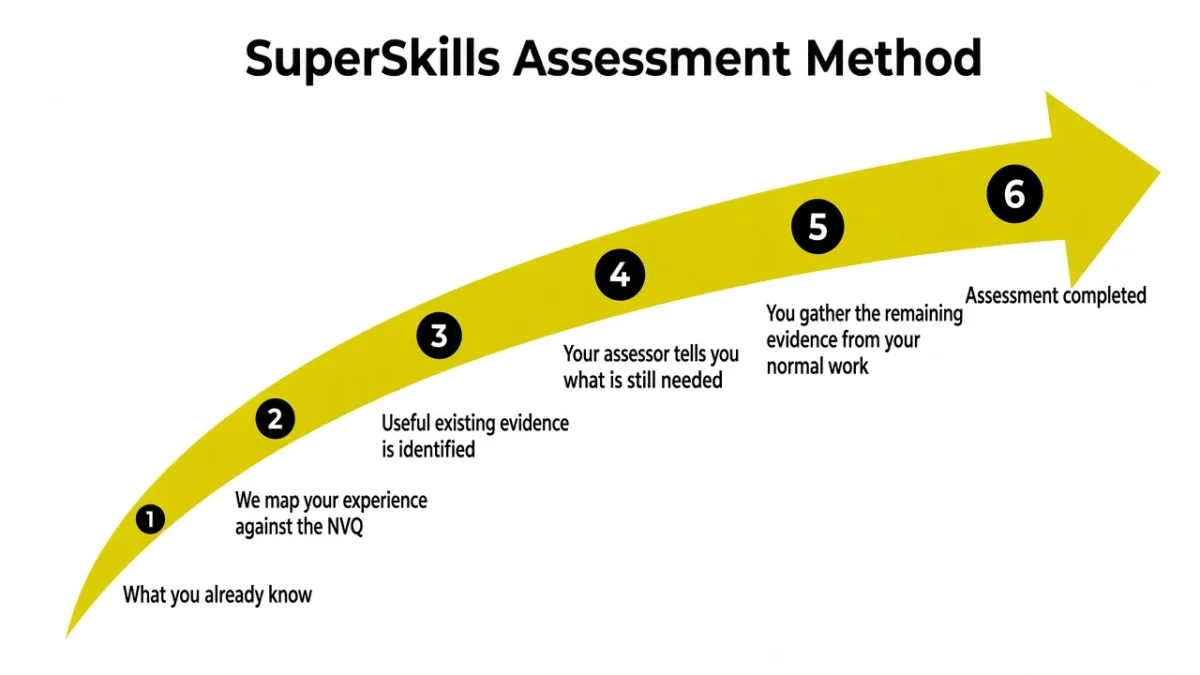
A good assessment normally starts by finding out what you actually do.
The assessor will look at your job, your normal tasks and the range of work available to you.
They can then work out:
- what your existing evidence already proves;
- what can be confirmed through questions or professional discussion; and
- what still needs to be seen or recorded during your current work.
This creates an assessment plan.
NOCN specifically requires an assessment plan to be agreed with the candidate when RPL is being used. The assessor should also help the candidate understand what evidence is required.
This is important.
You should not have to guess what to send.
Nor should you spend hours uploading hundreds of photographs in the hope that some of them might be useful.
The assessor’s job is to guide you towards the evidence that matters.
Can Old Site Photos Be Used?
Possibly.
NOCN does not set one fixed period after which evidence becomes too old.
Instead, the assessor decides whether it is still current enough to prove the required skill or knowledge. If there is doubt, the assessor can ask questions or ask the candidate to demonstrate the skill again.
For example, an older photograph of traditional carpentry work may still be useful.
Evidence relating to a working method, product or safety requirement that has since changed may need more support.
The key question is not simply:
“How old is it?”
It is:
“Does this still prove that the candidate meets today’s standard?”
Construction NVQs Still Need Workplace Evidence
This is one of the most important points to understand.
An NVQ is a competence-based qualification.
For construction NVQs, candidates normally have to show that they can carry out the work in a real working environment.
For example, NOCN’s current Level 2 Site Carpentry qualification says that it has been designed for achievement in a real workplace. Candidates must be in a suitable work role and have access to the assessment opportunities needed for the qualification.
Individual construction units can go further.
NOCN states for units such as first fixing and second fixing that practical workplace evidence cannot be simulated. A recent carpentry candidate was getting frustrated because he was on a job fitting fire doors. To make progress (and without speaking to his assessor) he purchased some timber from a builder’s merchant and ‘created’ a studwork frame on his lawn. Unfortunately all the expense and hard work went to waste because the assessor could not use that evidence.
Assessors must also use a suitable mix of assessment methods.
So RPL does not turn a construction NVQ into a paperwork exercise.
The assessor still has to prove that you are competent at the job.
Can You Get Your Whole NVQ Through RPL?
Normally, you should not expect to.
This is where NOCN’s current policy is particularly important.
NOCN says that RPL can be used towards individual units. However, using RPL for a complete qualification is restricted.
Its policy states that NOCN will typically allow up to 50% of a qualification to be awarded through RPL.
Using RPL beyond that would normally need written approval from NOCN in exceptional circumstances.
There is another important rule.
Evidence being submitted specifically as RPL must have been gained before you started your programme or course.
So how can an experienced tradesperson still complete an NVQ quickly?
By combining different forms of assessment.
Suitable evidence from before registration may be recognised through RPL.
The remaining requirements can then be assessed through your current work.
That might involve photos and video from site, professional discussion, questions, witness evidence or direct assessment where required.
This is an important distinction.
You are not avoiding assessment.
You are avoiding unnecessary learning.
Why Can This Make an NVQ Much Faster?
Many training programmes start with the assumption that you need to be taught.
RPL starts somewhere else.
It asks:
What do you already know?
For a seasoned tradesperson, that can save a lot of time.
There is little value in teaching someone a basic skill that they have used correctly for the past ten years.
Instead, the assessor can concentrate on proving competence and filling any gaps in the evidence.
NOCN itself says that RPL can prevent unnecessary learning and allow training to be tailored around what the candidate actually needs.
This is why RPL can be so useful for experienced workers.
However, fast does not mean easy.
The National Occupational Standards stay the same.
The process is quicker because the candidate already has the skills, not because the assessor lowers the standard.
How Does Remote Fast-Track Assessment Fit In?
This approach works particularly well with remote NVQ assessment.
An experienced worker does not necessarily need to leave site and go back to college simply to prove skills they already use at work.
SuperSkills’ Fast Track Remote Assessment route is a good example.
Assessment is designed around the candidate’s normal work. Evidence can usually be gathered remotely, while professional discussions allow the assessor to check knowledge and confirm what the candidate did.
Where evidence gained before registration meets NOCN’s RPL rules, it can be considered as prior learning.
Where fresh evidence is needed, it can often be gathered from work the candidate is carrying out now.
The two methods therefore work together.
That is what makes the process quick and convenient for an experienced tradesperson.
The candidate keeps working.
The assessor builds the evidence needed for the NVQ around that work.
Some qualifications or units may still need a site visit, direct observation or another set form of assessment. RPL cannot be used to remove a mandatory assessment requirement.
What If Your Old Evidence Is Not Enough?
That is not necessarily a problem.
Very few candidates arrive with a perfect set of evidence covering every part of an NVQ.
If your old evidence covers only part of a unit, NOCN allows other assessment methods to be used to complete it.
Your assessor might ask you to:
- take photos or video when you next carry out a certain job;
- discuss the work with them;
- answer some questions;
- obtain suitable witness evidence; or
- demonstrate the task during normal site work.
The aim is to fill the gaps.
For an experienced tradesperson who is still doing the job, those gaps can often be filled quite quickly.
Is RPL the Same As Having an Old Qualification?
Not quite.
NOCN makes a distinction between RPL and Accreditation of Prior Certificated Learning (APCL).
RPL can recognise skills and knowledge gained through work and other experience.
APCL deals with formal qualifications or units you have already passed.
For APCL to apply, the previous certificated achievement needs to match the current unit requirements. NOCN must approve its use. NOCN says this is likely to apply only in relatively rare cases.
For many experienced construction workers, RPL is more relevant because much of their skill was learned through years of work rather than through formal study.
Who Is RPL Most Useful For?
RPL is particularly useful for experienced workers who are already doing the job covered by the NVQ.
That might include:
- carpenters and joiners;
- bricklayers;
- painters and decorators;
- plasterers;
- dry liners;
- roofers;
- tilers;
- groundworkers;
- construction operatives; and
- supervisors.
It is much less useful if you are new to a trade.
If you cannot yet carry out the work to the required standard, you need training and experience rather than simply a quicker assessment.
RPL recognises skills you already have.
It cannot replace skills you have not yet learned.
What Should You Gather Before Speaking To an Assessor?
You do not need to spend a weekend trying to build an NVQ portfolio yourself.
Start with the obvious things.
Look for some good examples of your work. Find any photos, job records or certificates you already have.
Then think about the range of work you normally carry out.
Speak to the assessor before collecting large amounts of evidence.
They can tell you what is useful and what the qualification actually requires.
This will normally save far more time than sending hundreds of random site photographs.
Does Using RPL Make Your NVQ Less Valuable?
No.
NOCN states that there should be no difference in the required standard whether achievement is reached through RPL or through a formal programme of learning.
The same qualification requirements still have to be met.
RPL assessment must also be recorded and quality assured.
The centre’s Internal Quality Assurer (IQA) can check assessment decisions, while NOCN can review the use of RPL through its External Quality Assurance (EQA) process.
So RPL does not mean that somebody simply signs off your experience.
Your experience must provide suitable evidence.
The assessor must then make a proper assessment decision.
For Experienced Workers, Your Job Should Be the Starting Point
If you have spent years learning your trade, getting an NVQ should not mean pretending that you are a beginner.
The sensible starting point is the work you already know how to do.
Recognition of Prior Learning gives an assessor a formal way to recognise suitable skills and evidence gained before you started the qualification.
Current workplace assessment can then prove the remaining requirements.
For an experienced construction worker, that combination can provide a much quicker route to an NVQ than a programme designed to teach the trade from the beginning.
That is also why remote fast-track assessment works so well for many experienced candidates.
You do not get the qualification instead of proving your competence.
You get it by proving that the competence you already use at work meets the required NVQ standard.
And, in many cases, you can do that without stepping off site.